Midpoint in Screenwriting: A Structural Necessity for Dramatic Dynamism

Abstract
The midpoint is one of the key yet underexplored elements within the classical three-act structure of screenwriting. This article employs an analytical-theoretical approach to examine the position, function, and dramatic necessity of this element within screenplays. Drawing upon the theories of Aristotle, Syd Field, John Truby, Robert McKee, Christopher Vogler, and other prominent theorists, it demonstrates that the midpoint not only serves as a structural link between the two halves of a story but also plays a decisive role in the psychological transformation of characters, the intensification of dramatic tension, and the narrative’s directional flow. The article further investigates the differing functions of the midpoint in classical versus anti-plot (non-traditional) narratives, emphasizing its flexibility and narrative utility across various storytelling styles. Ultimately, the conclusion underscores the midpoint as the pivotal hinge of the second act—a necessary element for maintaining narrative coherence and effectively guiding the audience throughout the screenplay.
Keywords: midpoint, three-act structure, screenwriting, drama, Syd Field, classical narrative, character transformation
- Introduction
Drama is fundamentally based on tension. Without tension, neither characters are formed nor actions that culminate in a coherent story. From this perspective, a screenplay is more than just a sequence of events; it is a dramatic structure designed to maintain coherence, suspense, and character development. One of the key hinges in this structure is the “midpoint”—a point that, like a hinge, connects the first half of the narrative to the second and serves as the source of a fundamental transformation in either the plot’s action or the inner life of the characters.
The three-act structure, systematized notably by Syd Field in his book Screenplay (1979), has today become a common language in screenwriting. Although this structure may appear modern on the surface, it has deep roots in Aristotelian theory, where Aristotle in the Poetics considers a complete work to consist of a beginning, middle, and end. However, unlike the beginning and the end, which have clear roles and defined functions within the structure, the middle of the narrative—especially the midpoint—remains a challenge for many writers.
The second act, which encompasses half of the screenplay’s duration, is the most difficult section for maintaining a balance between dramatic tension and character development. Many screenwriters regard this section as a “narrative labyrinth,” where sustaining rhythm and coherence requires precise storytelling techniques. The midpoint, as a transformative moment within this act, can serve as a structural solution to this crisis.
The aim of this article is to examine the position and function of the midpoint within the classical screenplay structure—an element that not only alters the course of action but also plays a decisive role in character transformation, the creation of suspense, and audience guidance. Following a review of prominent theories in this domain, the narrative, psychological, and structural functions of the midpoint will be analyzed.
- Theoretical Background
The analysis of narrative structure and screenplay design has long been a fundamental concern for theorists of drama and cinema. The roots of narrative structure discussions trace back to ancient Greece and the works of Aristotle. In Poetics, Aristotle conceptualizes the ideal structure of any dramatic work as consisting of a “beginning, middle, and end,” emphasizing that these three components must be connected in a logical and causal relationship (Aristotle, Poetics, trans. Heath, 1996). This foundational tripartite forms the core of classical narrative structure and was particularly redefined and systematized in the twentieth century by theorists such as Syd Field through the Three-Act Structure.
Syd Field, in his book Screenplay: The Foundations of Screenwriting (1979), proposed the three-act structure as an effective framework for organizing narrative in screenplays. He posits that the first act is dedicated to the introduction of characters and setting, the second act to conflicts and character development, and the third act to resolution and conclusion. In his later book, The Screenwriter’s Problem Solver (1994), Field introduces the concept of the midpoint as a structural solution for crises occurring in the second act—a moment in the middle of the story where a significant and unexpected event changes the course of action and directs the narrative toward the third act.
Numerous theorists following Field have emphasized the key role of the midpoint. Stanley Williams (2006), in The Moral Premise, refers to it as a “dignified moment” reflecting the character’s moral or psychological crisis. James Scott terms this the “mirror moment”—the point at which the character confronts their true self for the first time. Robert McKee (1997), without directly naming the midpoint, discusses the central event that disrupts the story’s balance and ushers opposing forces into a critical phase.
On a macrostructural level, Joseph Campbell’s The Hero with a Thousand Faces (1949) and Christopher Vogler’s The Writer’s Journey (1992) indirectly describe the midpoint within the Hero’s Journey paradigm as the “ordeal” or “innermost cave”—the stage where the hero faces a pivotal crisis or discovery that transforms the subsequent journey. John Truby (2007), taking a more practical approach in The Anatomy of Story, views the midpoint as the psychological turning point of the character, where internal and external actions intertwine and the narrative enters a new phase.
Complementing these views, David Bordwell (1985), in Narration in the Fiction Film, offers a historical perspective and argues that the three-act structure, particularly Syd Field’s model, has extensively influenced modern American screenwriting and become an industry standard. Bordwell states, “At least two generations of American screenwriters owe their craft to the model Syd Field presented in 1979.”
Based on this theoretical background, the midpoint can be regarded not merely as a structural element but as an effective tool for managing dramatic crises, deepening psychological character development, and advancing the narrative smoothly through the middle of the story.
- Analysis of the Midpoint’s Function in Screenplay Structure
In the three-act structure, the second act carries the greatest duration and dramatic weight. This act serves as the connection point between two critical moments: the first plot point, which initiates the main story trajectory, and the second plot point, which sets the stage for resolution. Within this framework, the midpoint, as a pivotal element at the heart of the second act, plays a vital role in sustaining tension and driving character development.
3.1. The Midpoint as a Structural Knot
Syd Field does not explicitly term the midpoint the “second turning point,” yet he regards it as a type of plot point that fundamentally alters the story’s trajectory (Field, 1994). Positioned at the narrative’s fulcrum, structurally it functions like a hinge, connecting the first half of the story to the second. The significance of this point lies in the fact that without it, the screenplay risks losing momentum and rhythmic coherence—particularly in the first half of the second act, where the threat of narrative decline is greatest.
Narratively, the midpoint comprises information or an event that abruptly alters the audience’s perception of the story. This change may manifest as a discovery, crisis, failure, or even an emotional and internal moment; however, it invariably serves a structural function: guiding the narrative from a phase of growth to a phase of crisis.
3.2. The Midpoint and Character Transformation
John Truby argues that a story ultimately consists of a character’s actions (Truby, 2007). From this perspective, a character embarks on a narrative path motivated by either internal desire or external goals and encounters obstacles originating from the first act. The midpoint is the moment when the character can no longer remain passive. They must transition from a reactive stance to active engagement—both externally (practical action) and internally (belief changes, internal conflict, psychological awakening).
For example, in many films, the midpoint coincides with the character’s “first serious defeat” or “first bitter discovery,” a moment when the character realizes that what they desired is not easily attainable or was fundamentally mistaken. At this juncture, the character is compelled to reconsider their goals, tools, or trajectory.
3.3. Midpoint as the Second Inciting Incident
The inciting incident typically occurs in the first act and serves as the logical cause for the first plot point. From this viewpoint, the midpoint can be understood as the second inciting incident—an event that once again disrupts the story world and creates a new reality for the characters. Although this interpretation is not explicitly stated in Syd Field’s works, an analytical look at the structural and dramatic role of the midpoint supports this as a novel framework for understanding its function in narrative.
More precisely, a plot point marks the moment when an act reaches informational saturation—that is, when the character is placed on a path and all necessary information and obstacles have been presented to the audience. At this saturation point, the audience becomes ready to accept a new set of events and developments. Therefore, the midpoint is essential for a story.
In the second act, which comprises half of the story, the midpoint functions as a hinge enabling a full rotation of the narrative events—both in terms of the character’s internal dimension and the external narrative. This rotation transforms the character from a reactive to an active agent and propels the story toward the second plot point and eventual resolution.
Thus, the midpoint can be regarded as the second inciting incident, which, while maintaining the three-act structure, plays a key role in generating suspense, enhancing dramatic momentum, and deepening the psychological development of the character. This new interpretation could stimulate further theoretical and practical discussions in screenwriting.
3.4. The Role of the Midpoint in Anti-Plots
In anti-plot narratives, the classical structure is altered. Causal relationships weaken, characters may lack long-term goals, and meaning sometimes becomes apparent at the story’s outset. Nonetheless, even within these experimental forms, the midpoint can serve a crucial function. Although it may appear structurally loose, through techniques such as positioning, defamiliarization, or meaning transfer, it performs a covert role in maintaining narrative rhythm. In other words, the midpoint in anti-plots is not necessarily structural but rather conceptual and symbolic.
- Conclusion
The midpoint, superficially a structural element situated within the second act of the screenplay, can be more profoundly regarded as the beating heart of the narrative. This point not only balances the two halves of the story but also plays a vital role in character transformation, maintaining dramatic tension, and directing the unfolding of the plot.
The midpoint allows the writer to prevent the collapse of rhythm and loss of momentum in the second act—an act which, due to its length and complexity, is among the most challenging segments in screenwriting. It may manifest as a personal revelation, emotional crisis, external failure, or even the revelation of a harsh truth; however, it consistently serves a central function in character development.
In classical theories such as Syd Field’s three-act structure, the midpoint holds a fixed place in the middle of the narrative and acts as a cohesive element linking the story to subsequent actions. Theories by John Truby, Robert McKee, and Christopher Vogler also acknowledge the midpoint’s significant, albeit sometimes implicit, presence. Even in anti-plots, which emphasize chance and structural disruption, the midpoint can function at a semantic and conceptual level.
Accordingly, it can be asserted that across all types of narratives—classical to modern, structural to experimental—the midpoint is a key element for maintaining coherence, psychologically guiding the character, and engaging the audience. Its absence may lead to structural fragility and discontinuity in the story’s progressive flow. Therefore, the midpoint is not merely a plot point but a dramatic necessity at the core of the screenplay.
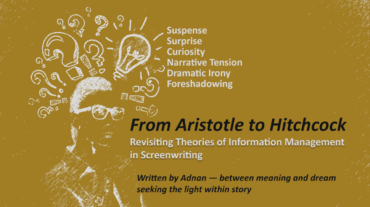
Written by Adnan — forever caught between the weight of meaning and the freedom of dreams, a follower of the shadows of thought in search of the light within the heart of story.
References
Aristotle. (1996). Poetics (M. Heath, Trans.). Penguin Classics. (Original work published ca. 335 B.C.E.)
Bordwell, D. (1985). Narration in the fiction film. University of Wisconsin Press.
Field, S. (1979). Screenplay: The foundations of screenwriting. Dell Publishing.
Field, S. (1994). The screenwriter’s problem solver: How to recognize, identify, and define screenwriting problems. Dell Publishing.
McKee, R. (1997). Story: Substance, structure, style and the principles of screenwriting. ReganBooks.
Scott, J. (n.d.). The mirror moment [Lecture or article]. Retrieved from https://jamesscottbell.com
Truby, J. (2007). The anatomy of story: 22 steps to becoming a master storyteller. Faber & Faber.
Vogler, C. (1992). The writer’s journey: Mythic structure for writers. Michael Wiese Productions.
Williams, S. (2006). The moral premise: Harnessing virtue and vice for storytelling success. Michael Wiese Productions.